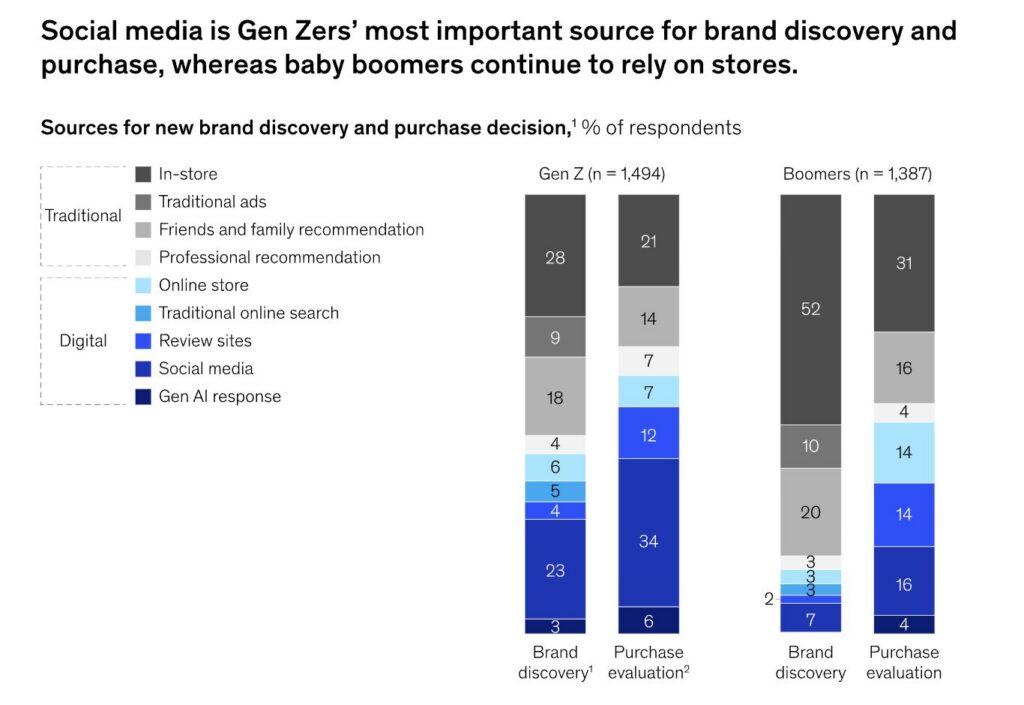
Resale has been booming for years – mainly led by Gen-Z – driven by rapid tech advancement and cost sensitivity. It’s AWESOME. But this could all collapse if the resale sector doesn’t quickly measure the shift currently operating in the field.
Agentic commerce – where AI agents discover, compare, and increasingly transact on a shopper’s behalf — is already here. Most players are putting their head in the sand and pretending it’s not for them. But that’s like being in the year 2000 and not believing in the internet.
Here’s the reality.
1. Young people shop by image, not text
Young people today shop by image, not lengthy product descriptions and keywords. This changes everything in a platform’s architecture: semantic vs. visual search. A resale catalogue built for keyword queries isn’t built for the way the next generation actually browses.
2. AI surfaces are becoming the new storefront
More and more shoppers use new AI surfaces: Gemini, ChatGPT, Perplexity, and others. Which means product catalogues need to be normalised, enriched, and conversation-ready to be visible. Most aren’t. If an agent can’t read and understand your listings, your inventory effectively doesn’t exist in that channel.
3. Payment providers are becoming shopping platforms
Payment providers “own” the customers and know them best – so they’re becoming the shopping platforms. From the shopper’s agent to the brand’s agent, they’re best placed to facilitate and authenticate transactions. Whoever sits closest to the payment sits closest to the sale.
Why I started building faircado
I started to build faircado the day I realised that, on this beautiful planet:
- 🗑️ We throw a rubbish truck full of clothes into landfill every second
- 👗 We already have enough clothes to dress the next 6 generations
- 🤯 Yet we still produce 100 billion new garments every year
This is insanity.
We HAD to find a way to do better than this.
So we built the first system able to aggregate, normalise, and enrich millions of second-hand product listings from all across the internet into one place — so it would become super easy for anyone to find what they were looking for.
Image matching, Pinterest integration, virtual try-on… it quickly became one of Gen-Z’s favourite apps. That’s given us incredible insights into the evolution of shopping behaviours, and I’m honestly afraid of how things will end for “traditional” players who refuse to see the urgency.
Because making second-hand the first choice of every consumer will only work with a strong, future-proof resale infrastructure. Onwards and upwards! 🚀
What I usually get asked
What is agentic commerce?
Agentic commerce is a way of shopping online, where AI agents discover products, compare options, and increasingly also complete purchases on a shopper’s behalf. This is replacing the “old-school” way of shopping through browsing, text search, and buying manually.
Why does agentic shopping matter for resale?
Second-hand listings are very different from regular e-commerce data. Second-hand catalogues are messy and non-standardised by nature. If listings aren’t normalised, enriched, and readable by AI agents, they won’t surface in agent-driven discovery – leaving resale invisible in the channel where a growing share of shoppers, especially Gen-Z, now start.
How can resale platforms prepare for agentic shopping?
By investing in visual (not just text) search, normalising and enriching product data so it’s conversation-ready for AI surfaces, and understanding the growing role of payment providers in authenticating and facilitating agent-led transactions.
PS 1: Read McKinsey & Company’s new State of the Consumer 2026 to learn more about “the new tech-driven path to purchase: how people discover and decide is changing rapidly.”
PS 2: I’ll be on stage across Europe over the next few months to talk about the future of shopping – and the role of resale, agentic commerce, and Gen-Z in it. Hit me up if you’re planning to be at TechBBQ in August, DMEXCO in September, or Recommerce Buzz in October. I’d love to chat!
Evolena de Wilde is the Founder & CEO of faircado; a version of this piece first appeared on Evolena’s LinkedIn.