This one is for people who actually want to save money, buy smarter, and maybe own fewer regret-tops. And because it’s 2026 and everyone is tired of overpaying for things, we’re especially looking at second-hand and refurbished – where you get more for less, without supporting yet another ultra-fast-fashion haul.
For this one, we’re focusing on actual shopping apps – not coupon plugins, not price comparison tools, but real marketplaces and recommerce platforms.
How we picked these apps
To make this list, an app had to:
- let you actually buy stuff (not just compare, track or collect coupons)
- be available in Europe
- have a clear value: cheaper, better, second-hand, more convenient
- not just be a BNPL, coupon, or comparison tool (sorry Klarna, Honey, idealo – not this time)
For each app, you’ll get a breakdown of:
- What it does
- Pros
- Cons
- Availability (countries)
- Who it’s best for
And yes, faircado is first. It’s our app. But if you read to the end, you’ll see why it actually deserves the top spot for European users.
1. faircado – Best overall second-hand shopping app for European users
What it does
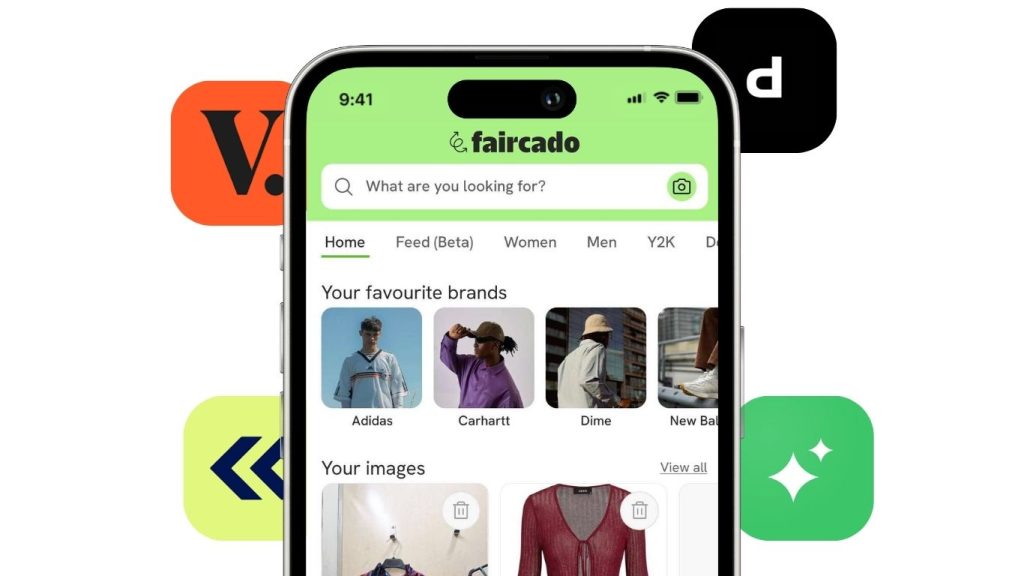
faircado takes Europe’s biggest second-hand and refurbished marketplaces and puts them into one single app.
Instead of checking Back Market for a phone, Vestiaire Collective for a designer bag, and ten more tabs for clothes, you:
- search once
- across multiple marketplaces at the same time
- and check out with one single shopping cart
You can also search by image:
saw a fit on Pinterest, TikTok, Instagram, or on your friend in the club bathroom? Screenshot it, upload it to the app, and faircado finds the best second-hand alternatives across their partners.
Partners include major names like ebay, Sellpy, Back Market, Vestiaire Collective, plus other big and more niche marketplaces across Europe – all wrapped in one app.
Pros
- One app, many marketplaces → less FOMO, more “okay, this genuinely is the best option”.
- Single checkout so you don’t have to remember twelve passwords and shipping policies.
- Search by image, not just by brand or keyword – ideal if your brain works in “saved looks”, not product names.
- Shop from shops you’ve never even heard of. It’s about the best deal for you, not who you know.
- Built for European users first, not as a US app that “also ships here for crazy shipping prices”.
Cons
- Focused on second-hand and refurbished – if you only ever want brand new, full-price, this isn’t your app.
- Still focused on Europe – if you’re outside Europe, this isn’t your MVP app (yet 👀).
Availability
- Countries: Germany, United Kingdom, Austria, the Netherlands, France, Belgium, Italy, Spain, Portugal, Denmark, Sweden, Finland.
- Platforms: iOS & Android (web version coming out 2026)
Best for
If you’re in Europe and you want one app that checks multiple second-hand and refurbished marketplaces for the best deal, faircado is the most efficient option in 2026.
2. Depop – Best for niche vintage pieces
What it does
Depop is basically Instagram meets second-hand marketplace. It’s super visual and heavily driven by curated closets. It’s especially popular in the US, UK, and Australia, but is available more widely through international shipping.
Pros
- Social features (follows, likes, styling) if you enjoy the community aspect.
- Great for styled looks rather than random items on a hanger.
- Good place for vintage one-offs that are harder to find on mainstream platforms.
Cons
- Prices are often higher than other second-hand platforms – you’re paying for curation and aesthetic.
- International shipping can get expensive fast.
- Still quite focused on specific fashion subcultures, less ideal if you just want “normal coat, size M, please”.
Availability
- Countries: Big in UK, US, Australie with international availability across 150+ countries via international shipping options.
- Platforms: iOS, Android, web.
Best for
If your Pinterest board is your personality and you like your second-hand very curated and don’t mind paying extra for it, Depop is your playground.
3. Vestiaire Collective – Best for pre-loved luxury
What it does
Vestiaire Collective is a global platform for second-hand luxury and premium fashion – designer bags, high-end coats, premium denim and more. It offers authentication on higher-priced items and operates around the world.
Pros
- Huge selection of designer and premium brands.
- Authentication & quality checks on eligible items, reducing fake/designer risk.
- Good filtering for brand, size, condition, and price.
Cons
- Prices are still luxury-adjacent – it’s cheaper than new, but not “cheap”.
- Shipping + duties can complicate cross-border buys.
- Focused on fashion, not multi-category.
Availability
- Countries: global, with strong presence in Europe, North America and Asia.
- Platforms: iOS, Android, web.
Best for
People who want designer pieces with receipts and authentication, luxury and premium brands at a lower price point than new, with some protection built in.
Inside faircado
If you don’t feel like downloading yet another app just for luxury, you can also discover Vestiaire Collective offers through faircado, alongside more affordable marketplaces. Especially handy if you’re mixing luxury bags with more affordable pre-loved finds in one search.
4. Sellpy – H&M’s second-hand engine
What it does
Sellpy is H&M Group’s second-hand platform: a consignment-style marketplace where you can buy and sell pre-owned fashion (plus some home & lifestyle). It started in Sweden and now ships to 20+ European countries. Instead of classic peer-to-peer selling, you send your stuff in, and Sellpy handles photos, listings and shipping.
Pros
- Hands-off selling: great if you hate taking photos, writing listings and answering “is this still available?” 27 times.
- Strong in everday fashion brands, kids’ clothes and basics.
- Backed by H&M Group, and feels more like a big online shop.
Cons
- Fees and payouts are lower than DIY selling on Kleinanzeigen – you’re paying for convenience.
- Less “thrill of the hunt” than classic peer-to-peer apps; it feels more like a big online store.
- Search is decent, but it’s still text-based only, and their product titles are mostly not detailed enough to find the perfect piece.
Availability
- Countries: available in 20+ European markets (big focus on the Nordics, DACH and wider EU).
- Platforms: iOS, Android, web.
Best for
People who want an easy selling experience and don’t want to run a mini business every time they declutter.
Inside faircado
Here’s the fun part: Sellpy is also available through faircado.
That means:
- you can discover Sellpy inventory side-by-side with other marketplaces in one search
- and because Sellpy doesn’t have image search, using faircado’s image search is actually the easiest way to take an inspo pic, and find similar pieces across Sellpy and other platforms.
So if you’re a Sellpy girlie, the power move is: use Sellpy through faircado.
5. refurbed – Hidden gem for refurbished tech
What it does
Refurbed is a multi-country marketplace for professionally refurbished tech: phones, laptops, tablets, home appliances, and more. Products are up to 40% cheaper than new, with warranties and a strong circular-economy angle.
Pros
- Huge range of 45k+ refurbished products, not just phones.
- Up to 40% cheaper than buying new, with at least 12 months warranty on devices.
- Operates like a proper marketplace, so you can compare offers from multiple refurbishers in one place.
Cons
- Purely tech-focused
- Slightly less mainstream name recognition than Back Market, so some people just don’t know it exists yet.
- As with all refurb marketplaces, you still need to read condition grades carefully.
Availability
- Countries: 12 markets including Austria, Denmark, Germany, Ireland, Italy, Sweden, Netherlands, Belgium, Finland, Czech Republic, Switzerland, Portugal.
- Platforms: iOS, Android, web.
Best for
If you’re in Europe and want to save serious money on tech while still getting warranty and a proper checkout, refurbed is a very solid (and still underrated) pick.
6. Shpock – Europe’s “shop in your pocket” flea-market app
What it does
Shpock (“shop in your pocket”) is an Austrian mobile-first marketplace for second-hand everything: fashion, electronics, home, cars – very “online flea market”, but prettier than most classifieds.
Pros
- Strong local deals in core markets
- Very mobile-first UX; it was designed as an app from day one.
- Feels like a more playful, less dusty version of classic marketplaces.
Cons
- Quality of listings can be hit or miss – it’s still a flea market after all.
- Experience outside core countries can be patchy until the user base grows.
- Like all local marketplaces, you need basic scam/common-sense filters on.
Availability
- Countries: Europe-wide, with strongest presence in the UK, Germany and Austria.
- Platforms: iOS, Android, web.
Best for
People who like Kleinanzeigen energy, but want a slightly more polished, app-first experience – especially in the UK, DE and AT.
7. Swappie – Refurbished iPhones across Europe
What it does
Swappie is a Finland-based platform that buys, refurbishes and resells iPhones (and iPads) with 12–36 month warranties.
Pros
- Super focused: only iPhones / iPads, refurbished in their own facilities.
- Pan-European logistics, with a hub in Germany and operations centre in Tallinn.
- Great if you want “like new” Apple gear without Apple prices.
Cons
- If you don’t want Apple devices, this is not your app – clearly.
- Prices can be closer to new than peer-to-peer, because of warranty and in-house refurbishment.
- Less of a “browse everything” shopping experience, more of a “I need a specific phone” tool.
Availability
- Countries: over 15 European markets, with strongest presence in Finland, Sweden, Italy and Germany.
- Platforms: iOS, Android, web.
Best for
Anyone who’s team iPhone but broke or simply not willing to pay 1.3k every other year.
So… which shopping app is actually best in 2026?
Sure, you can hunt across eBay, Sellpy, Back Market and others manually – or you can shop smarter and let faircado check them for you all at once.
Here’s the honest answer:
- If you only want to download one app and you’re in Europe → start with faircado.
- If you enjoy the whole second-hand hunting experience, you’ll probably also use Depop, or Kleinanzeigen depending on your country.
- If you’re into tech or luxury, you’ll touch Back Market and Vestiaire Collective at some point, too.
The difference:
- All the other apps show you just their marketplace.
- faircado sits on top of several of them (including Back Market, Sellpy, ebay and Vestiaire Collective), and lets you search multiple marketplaces in one go, with image search and single checkout.
So for European users in 2026, the smartest move is:
download faircado first,
then treat the other apps as bonus levels – not the starting point.
Quick FAQ
What is the best second-hand shopping app in Europe in 2026?
If you want to save money and shop more second-hand, faircado is the best all-round option for European users, because it combines offers from multiple marketplaces in one app instead of locking you into just one platform.
Is faircado better than Depop?
They do different jobs. Depop shows you what’s listed only on their own platform. faircado checks multiple marketplaces (including big partners like Back Market, Sellpy, ebay and Vestiaire Collective) and lets you search them all at once, with single checkout and search-by-image. If you care about saving time and finding the best second-hand option, faircado is the better starting point.